At 70, David’s three steps
Replace interest income, use his remaining RRSP room, then borrow $600,000 to leave his daughter $1.64 million more.

In Depth
While building wealth, put money in the right pockets. As retirement approaches, work through the numbers and plan the order. When it is time to draw income, take money from those pockets in the right order.
Book a Free Consultation
The earlier you prepare, the easier retirement becomes. The later you start, the steeper the climb.
Start at 20, and it takes the price of a bubble tea a day. Start at 60, and it takes $450 a day.

Put protection in place and organize your RRSP and TFSA, so slowing down at 40 can be a choice.
TFSA for growth, RRSP for tax deductions, FHSA for both.
Retirement depends on how you design it, not how much you cut back: RRSPs, TFSAs, participating policies and annuities work together.
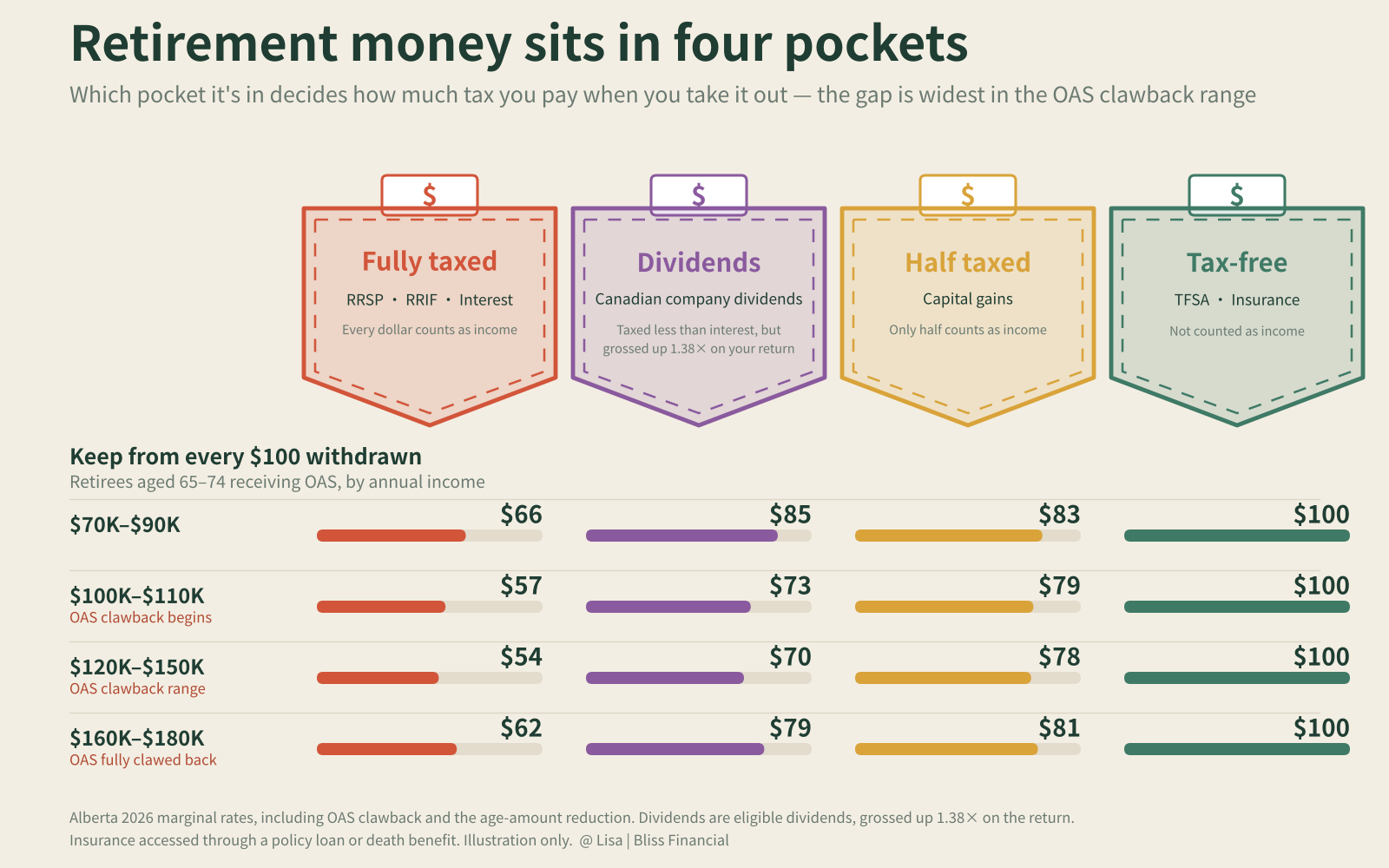
Fully taxable: RRSPs, RRIFs and interest. Dividends: included in income at 1.38 times the amount received. Half taxable: capital gains. Tax-free: TFSAs and insurance policies.
Withdraw the same $100 while your income is in the OAS clawback range: the fully taxable pocket leaves $54, while the tax-free pocket still leaves $100.
In the 10 to 15 years before retirement, work out the shortfall, where the money will come from and which pocket to draw from first.
Even full CPP and OAS provide about $2,270 a month. Living well takes preparation of your own.
A couple, both 58, reorganized their finances, retired at 62 and offset the tax on a property sale.
Mr. M, 64, planned gradual withdrawals from his $790,000 RRSP: $520,000 more for his children and $490,000 less in tax.
CPP, OAS and RRIF withdrawals begin at different times. The form of your income and the order of withdrawals determine how much tax you pay and what you leave to your family.
Replace interest income, use his remaining RRSP room, then borrow $600,000 to leave his daughter $1.64 million more.
More than $300,000 in your RRSP at 50, $500,000 at 60 or $1 million at 70? Start with a complete retirement withdrawal plan.